Showing posts with label Fiestas. Show all posts

Monday, May 16, 2011

Barangay Bayan-Bayanan and Maysilo

Sunday, May 15, 2011

Still on my Malabon fiesta tour....


BARANGAY BAYAN-BAYANAN
Feast of San Roque

Bayan-Bayanan Chapel at Celia II Street, Barangay Bayan-Bayanan.


XXX
BARANGAY MAYSILO
Feast of Nuestra Sra. dela Paz Y Buenviaje

Maysilo Chapel at Yanga Street, Barangay Maysilo.   I went to the Immaculate Heart of Mary Parish Church on M.H. del Pilar, thinking it was also their fiesta.  But I was told that it was the barangay of Maysilo and this chapel celebrating their fiesta today.


XXXX
XXXX

Sunday, May 8, 2011

Again, it's three fiestas in a day: Barangay Catmon, Niugan and Panghulo

As far as I'm concerned, it's official:  May is fiesta month in Malabon!

Including today's fiestas, seven barangays in Malabon have had their fiestas so far this month.  And between today and the end of May, another three barangays will be celebrating.

Skies were a little overcast this morning when I left the house to make my rounds - but I was determined to take a peek at all the barangay fiestas this year. And those grey skies were not enough, either, to dampen the festive mood in each of the barangays I visited!  All three barangays were celebrating the Feast of Sta. Cruz (Feast of the Holy Cross), but based on the streamers I saw, each had their own way of calling their feast day in the vernacular.


BARANGAY CATMON
Pista ng Mahal na Poong Krus


Catmon Chapel on Dulong Hernandez Street, Barangay Catmon.  Holy Mass must have been scheduled at around 9:00am because when the ladies saw me get down from the car at around that time, one of them asked me if the priest was already with me.  The streamer nearby mentions the fiesta dates as May  7-8, 2011.

XXX
Street dancers going through their moves at the other end of Hernandez Street.


XXX

BARANGAY NIUGAN
Pista ng Banal na Krus


Niugan Chapel on N. Vicencio Street, Barangay Niugan.  Participating in the parade were at least three marching bands and some barangay officials.  A streamer nearby announced the holding of a "Serenata "by the Cardona 8 Band in front of the chapel the night before.


BARANGAY PANGHULO
Pista ng Mahal na Senor Sta. Cruz


Panghulo Chapel on Panghulo Road, Barangay Panghulo.


XXX
XXX

Wednesday, May 4, 2011

Barangay Hulong Duhat's turn to fiesta

It was Hulong Duhat's turn to fiesta yesterday.

I was able to to visit the place only this afternoon -- the buntings ("banderitas") were still up, so there was still a bit of the fiesta feeling.  An improvised stage was still set up, too. 

Fiesta activities included a pagoda (fluvial procession) on the Malabon River at 10:00am yesterday.  A "sagalahan" (procession of models) was also held on Saturday evening.  It would have been nice to watch the pagoda.  After watching my first-ever pagoda last December at the Barangay Concepcion fiesta, I suddenly feel like I've been missing out on something special all these years that I've been a Malabon resident.  So now I want to watch more pagodas!


BARANGAY HULONG DUHAT
Feast of Exaltation of the Holy Cross

Exaltation of the Holy Cross Parish Church on Gervacio Street, Barangay Hulong Duhat.  I was told that Bishop Deogracias Iniguez was to celebrate Mass at the chapel at 5:30pm yesterday.


XXX

Sunday, May 1, 2011

Three Fiestas in a Day: Barangays Acacia, Longos and Santulan

The merry month of May begins with three fiestas today in Malabon.

Since fiestas are commonly associated with the feast day of a patron saint, I went to the three barangays' chapels to take a quick look.  Except for the Longos chapel which is familiar to me because an old friend of mine used to live in that barangay, I didn't even know there were chapels located in barangay Acacia and Santulan.  We had to stop and ask around in order to find them.

And when we did find the chapel, there was no doubt that a fiesta was going on because of the festive buntings that decorated both the chapel and the street.


BARANGAY ACACIA
Feast of St. Joseph the Worker (San Jose)

Chapel located on Flerida Street, Barangay Acacia.  The image of St. Joseph is obviously being readied for a procession.


XXX
BARANGAY LONGOS
Feast of Senor de Longos

Chapel located on Borromeo Street, Barangay Longos.  There were banners located on Rizal Avenue announcing activities for the fiesta such as a walkathon, fireworks and procession.


XXX
BARANGAY SANTULAN
Feast of Mahal na Senor Sta. Cruz

Chapel located on Custodio Street, Barangay Santulan.  There was a small stage set up at the corner of the street, so there must be activities lined up for their fiesta as well. 


XXX

Sunday, January 2, 2011

Sto. Rosario Church and the Dampalit fiesta

New Year's Day was supposed to be fiesta day in Dampalit, so I dropped by in the morning before going to a family reunion.

I went to the Sto. Rosario Church, since the parish church is usually at the center of fiesta celebrations in a barangay. I did find it a little odd, though, that the Sto. Rosario Church would be celebrating its fiesta on January 1st instead of October during the month of the Holy Rosary.   So out of curiosity I went to the parish office in the hope that they could enlighten me.

I learned from Ate Rosie and Ate Sonia who happened to be there, that January 1st is actually the Barangay fiesta and the church used to celebrate its fiesta on the same day only because that had always been the tradition ("nakaugalian na").  During the time of Jaime Cardinal Sin, however, he told the parish to celebrate its feast during the month of October.  So Sto. Rosario Church now celebrates its feast on the second Sunday of October, although it also lines up some activities during the barangay fiesta day.  A pagoda (fluvial procession) on the Malabon River is held by the parish on the second Saturday of October.


A LOOK AT DAMPALIT CHURCH BEFORE

Dampalit Church c. 1963 (Photo from Arch. Richard Bautista

XX
A marker found inside the church gives the following information:
  • It was constructed by Augustinian Fathers in 1860.
  • In 1902, it was taken over by Aglipayans.
  • It was returned in 1907 by order of the Supreme Court.
  • The church served as a Japanese military garrison in World War II and reconstructed after the war.
  • The light of the church tower served as a navigational point of reference.
  • The chapel became a parish church in 1983 and was rebuilt in 1989.
  • The church was solemnly consecrated on October 13, 1991 by Jaime Cardinal Sin, Archbishop of Manila.

XXX
A LOOK TODAY

Sure sign of a fiesta going on:  a band in colorful uniform.

Another fiesta activity of the barangay, according to the streamer -- a Battle of the Bands

One of two antique bells that were found at the Sto. Rosario Church.  The inscription on the bell states:  "Devoto de Ntra. Sra. del Rosario, Ano 1860." 


The main altar

This image is said to be the original image found in the church.

Other images include a Sto. Nino dressed as a fisherman with his catch.

Except for the band in front of the church, looking at this morning street scene at Dampalit bridge, it seemed pretty quiet for a fiesta day.  Perhaps it was still too early (I came at around 10:00AM), considering that it was New Year's Eve the night before and most people must have been up late.


XXX

Friday, December 10, 2010

Fiesta time at Concepcion

This barangay certainly knows how to fiesta!   With three days of festivities each year (December 8, 9 and 10), of course it would have picked up more experience in celebrating fiestas than the rest!

December 8 is the Feast of the Immaculate Conception, which is mostly a religious celebration.

December 9 is the Pista ng mga Mangingisda (Fishermen's Festival).  By tradition, a motorcade is held in the morning from the Immaculate Conception Parish Church going to San Jose de Navotas.  The image of La Purissima Concepcion is joined by the image of St. Joseph in a motorcade going around Malabon and Navotas.  Then a Dalaw-Bahay follows, wherein the image is brought from one house to another.  The image is  then taken for a Pagoda (a fluvial or grand boat procession) on the Malabon River.

There is also a Pagoda in the morning held by the Aglipayan Church.  After the Pagoda on the Malabon River, the Caracol (street dancing) is held around Malabon.

December 10 is the Pista ng Barrio, the fiesta day for Barrio Concepcion.  The annual Pancit Malabon Festival is also held on this day.

In all the years that I've been a long-time Malabon resident, a good many of which were spent growing up in Barangay Concepcion, I had never seen the Pagoda - although I've heard about it.  And the Caracol - well, this was the first time I even knew about it!  So, of course I just had to go on the 9th to finally find out what they were all about.


THE MORNING PAGODA

My husband and I arrived at the Aglipayan Church on C. Arellano Street just in time, as the image of Our Lady was about to be brought out of the church.  We walked with the image a short distance away to the Raymundo compound where a boat was waiting to take it around the Malabon River.  

After the image was mounted on the boat, the pagoda went on its way by around 9:00am. Only a limited number of devotees are allowed to ride the boat because the MARINA (Maritime Industry Authority) and the Coast Guard are now strictly monitoring the conduct of pagodas.


Image of Our Lady is brought out of the church by devotees

kkkk

kkk


kkk
The pagoda is about to leave. 

kkk


 xxx

THE CARACOL

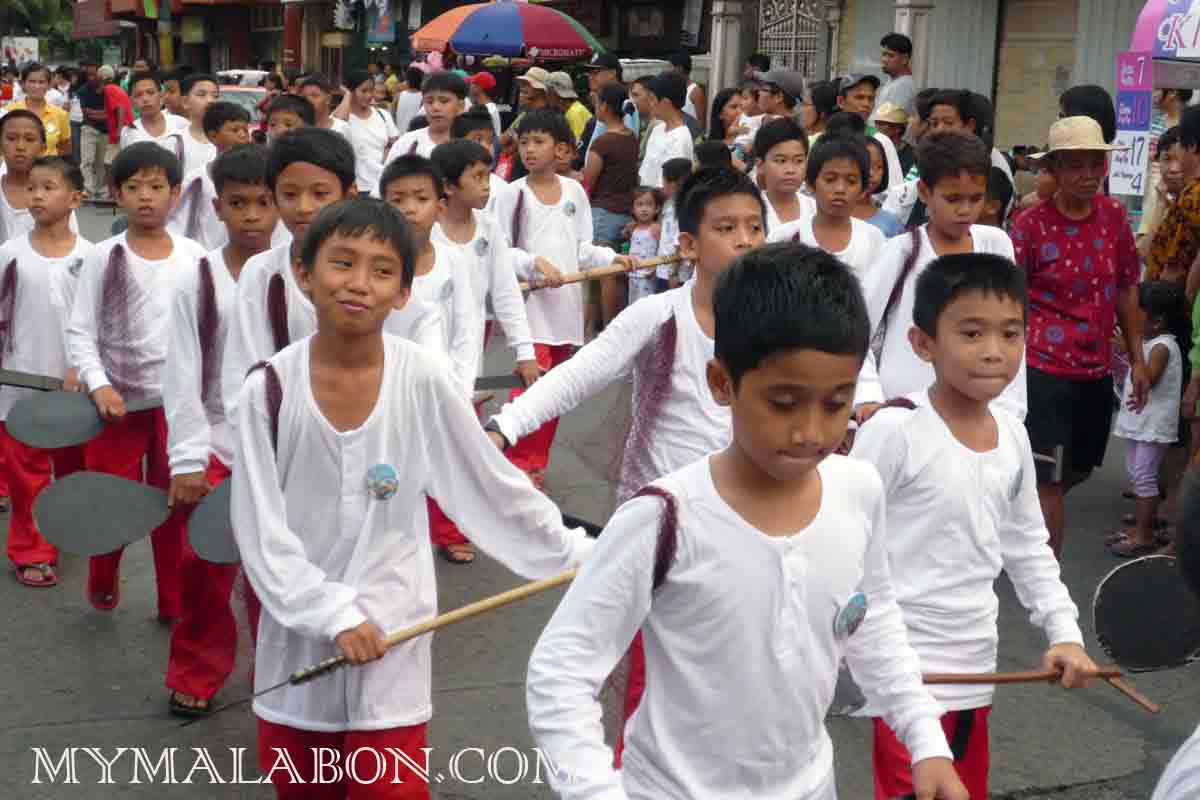
We went back in the afternoon just in time also to see the Caracol pass by the Visita.  (Visita is what the locals call the market of Barangay Concepcion.)  The Caracol dancers are mostly students from the different elementary schools in the city who dress in colorful themed costumes and dance to a lively caracol ditty. 


 xxx
THE EVENING PAGODA

As soon as I finished watching the Caracol, my husband and I took a pedicab and hurried to the Rufina Patis compound on C. Arellano Street in order to catch the evening pagoda.  By the time we got there, the image of the Immaculate Conception was inside the building and people were milling around, waiting for the pagoda to begin. After a few minutes more, the Caracol  also passed by Rufina Patis.

According to Monchet Lucas, the evening pagoda during the fiesta in Concepcion started a very long time ago, with different families taking charge of it every year.  But since 1946 after the war, it has been the Lucas family that has been taking care of the pagoda. 

The mounted image in the late afternoon


Bishop Deogracias Iniguez and the other priests wait for Mass to begin.
The Mass began at around 4:30 pm.
Mrs. Monina Lucas and Mrs. Alice Tanchanco waiting for the pagoda to begin after the Mass
The image at twilight (around 5:30pm) when the Mass ended.

The pagoda came back at around 7:30 pm.
The picture is a little hazy because of the smoke from the fireworks. 
Monchet Lucas and his father
Guest Vice Mayor Len-Len Oreta with Mr. Lucas

.

Wednesday, August 25, 2010

Fiesta time at San Bartolome

August 24, 2010 -- The San Bartolome parish celebrated its 396th feast today. The first parish priest of San Bartolome Parish Church, Fr. Luis Gonzales, was assigned there in 1614,  1 so this is apparently the basis for counting the years of its celebration, not the date the church was constructed.  


HOW DID SAN BARTOLOME BECOME THE PATRON SAINT OF THE PARISH?
It was part of an agreement between Nicolas Acerda Manapat, heir of the original land-owner Agustin Sigua upon whose land the church was built, and the Captain General and the Archbishop, that once the church was finished, the patron saint of the church will be the same as the name of his compadre Bartolome Mangay Mansano.  2   It should be safe to assume that Bartolome Mangay Mansano was named after San Bartolome or St. Bartholomew.


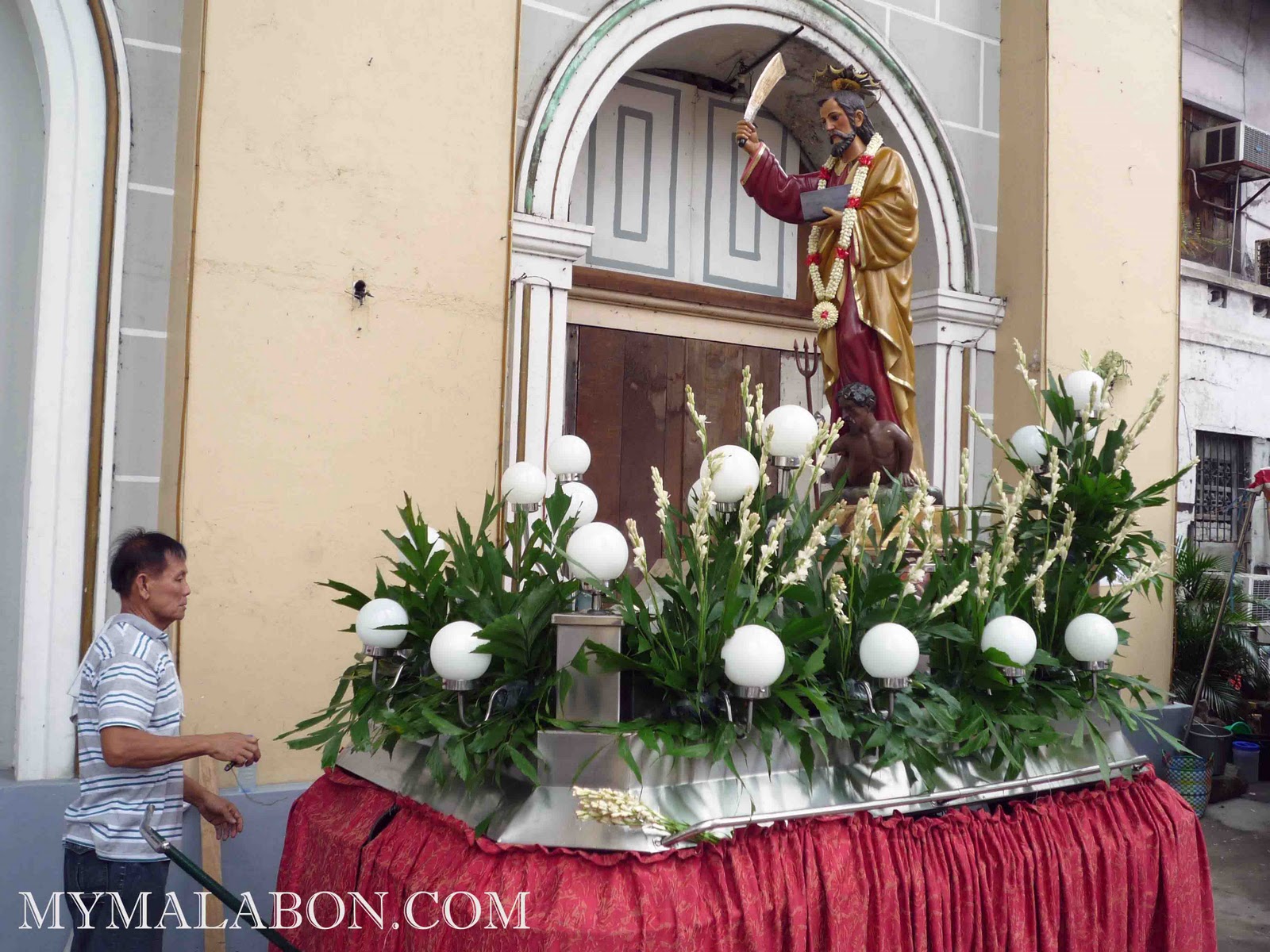
St. Bartholomew was one of the Twelve Apostles of Christ.  In St. John's Gospel, he is called Nathaniel.    He preached in India, which, during those days covered a wider area in the Near East.  He was said to have been skinned alive then beheaded.  In Michaelangelo's painting, the "Last Judgement" found in the Sistine Chapel, St. Bartholomew is shown holding a sheet of his own skin in his left hand and a knife in his right hand.  3/   Because of this, he has come to be associated with a knife, the instrument of his martyrdom. 

And this, in turn, is why on his feast day, every type of bladed instrument - balisongs, bolos, kitchen and butcher's knives - has traditionally been sold at the San Bartolome town fiesta.


HISTORICAL TIDBIT:  WHY WAS THE 1896 FIESTA OF SAN BARTOLOME SIGNIFICANT?
When the Katipunan was exposed through the confessional on August 19, 1896, the Spanish government threw a cordon around Manila, putting checkpoints and sealing all exits. Group movements were tightly monitored. Bonifacio issued a call for a general meeting in Balintawak to discuss the situation.

By pretending to be on their way to attend the fiesta of San Bartolome in Malabon, Katipuneros from the provinces were able to slip through the Spanish checkpoints.   They congregated in Balintawak, and on August 23, 1896, the eve of the feast of San Bartolome, Bonifacio and his men staged the Cry of Balintawak.  4 Thus did our bolo-wielding patron saint San Bartolome aid the Filipinos' revolt against the Spaniards.  It is also said that some of the Katipuneros bought their bolos from the stalls at San Bartolome.


SCENES FROM A FIESTA

San Bartolome parish in fiesta mode

Bishop Deogracias Iniguez led Vicariate clergy in a concelebrated Mass. 

Devotees line up to wipe the statue of San Bartolome

After the Mass.

San Bartolome getting ready for the evening procession

Banda Pula Original of Malabon on the patio.


Costumes for Sto. Nino statues.  Filipinos like to dress up their Sto. Ninos in different attires.

Colorful paper mache horses liven up the place.


DISCOVERY OF THE DAY:  MANG ROMY OF APALIT, PAMPANGA - LONE TABAK VENDOR AT MALABON'S 7th TABAK FESTIVAL


Yes, believe it or not, Mang Romy was the lone tabak vendor at the San Bartolome fiesta!

I walked the whole courtyard of San Bartolome; walked the stretch of Rizal Avenue from the corner of General Luna up to the City Hall; walked Leono and Manapat streets.  Nothing.  It was just Mang Romy in his stall near the parish convent building.  When I asked him where the other tabak vendors were, he said they were in Nagcarlan, Laguna - where there was also a San Bartolome fiesta.

But you used to be so many out here, I said. I remember that well because we lived across San Bartolome church in the 1980s. Yes, he agreed, dense rows of tabak vendors used to line up the street during the fiesta.  But since three years ago, his co-vendors have been choosing to go to Nagcarlan instead, because here in Malabon, sales are "matumal" (slow).  Mang Romy chooses to go to Malabon, though, because it has been the family practice since his grandfather's time.  I felt bad for him that I almost wanted to buy a bolo just so he could make a sale - but  I didn't know how to buy one!  And besides, my son and I were just going to ride a jeepney going back to Concepcion where we parked our car.  I would not want to be carrying a bolo on the jeepney!

As I turned to walk towards General Luna, I looked back and a thought crossed my mind.  If this trend continues, maybe next year, Mang Romy will opt to go where business is better, and go to Nagcarlan instead.  If that happens, the only bolo that will be left to show at San Bartolome's fiesta in Malabon will be San Bartolome's bolo itself!

For Malabon, history, and nostalgia's sake, I hope that never happens...


1/    From Tambobong to the City of Malabon, by Nonoy Marcelo, 2004.
2/    History of Malabon-Navotas, by Salvador Sevilla, Santos Tiangco, 1976.
3/    http://www.italian-renaissance-art.com/Last-Judgement.html
4/    Andres Bonifacio The Eve of St. Bartholomew, by Nick Joaquin.

.