San Bartolome Church is celebrating its quadricentennial next year and preparations are in full swing. I visited the church during our Visita Iglesia this year, and found that more renovation work has been done since I was last inside it in October 2011.
To see pictures I took, please go to: San Bartolome - preparing to celebrate 400 years
Showing posts with label San Bartolome Church. Show all posts
Showing posts with label San Bartolome Church. Show all posts
Wednesday, April 10, 2013

Tuesday, August 31, 2010
More old photos of San Bartolome Church
Because of its long history and grandeur, San Bartolome Church is obviously the most photographed church in Malabon. Thanks to some wonderful people who shared their old photos with me, I now have a mini-gallery which I would like to share with you as a way of capping the month of San Bartolome's feast.
 |
| Circa 1800s (Photo from PIO/Malabon and a Facebook friend) |
 |
| Circa 1800s (Photo from Arch. Richard Bautista) |
 |
| Circa early 1950s after the war. Note that up to this time, the church walls and its columns still have the original adobe exposed. (Photo from Ramon Manapat, taken by his father Nelson) |
 |
| Circa 1970s showing the Parish Rectory and Multipurpose Building (Photo from PIO/Malabon) |
 |
| Circa late 1960s/early 1970s. By this time, the adobe walls and columns had been plastered and painted. (Photo taken by Ramon Manapat) |
 |
| Note as of April 8, 2014: Please see comments below regarding period in which this photo might have been taken. (Photo from PIO/Malabon) |
.
Wednesday, August 25, 2010
Fiesta time at San Bartolome
August 24, 2010 -- The San Bartolome parish celebrated its 396th feast today. The first parish priest of San Bartolome Parish Church, Fr. Luis Gonzales, was assigned there in 1614, 1/ so this is apparently the basis for counting the years of its celebration, not the date the church was constructed.

HOW DID SAN BARTOLOME BECOME THE PATRON SAINT OF THE PARISH?
It was part of an agreement between Nicolas Acerda Manapat, heir of the original land-owner Agustin Sigua upon whose land the church was built, and the Captain General and the Archbishop, that once the church was finished, the patron saint of the church will be the same as the name of his compadre Bartolome Mangay Mansano. 2/ It should be safe to assume that Bartolome Mangay Mansano was named after San Bartolome or St. Bartholomew.

St. Bartholomew was one of the Twelve Apostles of Christ. In St. John's Gospel, he is called Nathaniel. He preached in India, which, during those days covered a wider area in the Near East. He was said to have been skinned alive then beheaded. In Michaelangelo's painting, the "Last Judgement" found in the Sistine Chapel, St. Bartholomew is shown holding a sheet of his own skin in his left hand and a knife in his right hand. 3/ Because of this, he has come to be associated with a knife, the instrument of his martyrdom.
And this, in turn, is why on his feast day, every type of bladed instrument - balisongs, bolos, kitchen and butcher's knives - has traditionally been sold at the San Bartolome town fiesta.
HISTORICAL TIDBIT: WHY WAS THE 1896 FIESTA OF SAN BARTOLOME SIGNIFICANT?
When the Katipunan was exposed through the confessional on August 19, 1896, the Spanish government threw a cordon around Manila, putting checkpoints and sealing all exits. Group movements were tightly monitored. Bonifacio issued a call for a general meeting in Balintawak to discuss the situation.
By pretending to be on their way to attend the fiesta of San Bartolome in Malabon, Katipuneros from the provinces were able to slip through the Spanish checkpoints. They congregated in Balintawak, and on August 23, 1896, the eve of the feast of San Bartolome, Bonifacio and his men staged the Cry of Balintawak. 4/ Thus did our bolo-wielding patron saint San Bartolome aid the Filipinos' revolt against the Spaniards. It is also said that some of the Katipuneros bought their bolos from the stalls at San Bartolome.
SCENES FROM A FIESTA


DISCOVERY OF THE DAY: MANG ROMY OF APALIT, PAMPANGA - LONE TABAK VENDOR AT MALABON'S 7th TABAK FESTIVAL

Yes, believe it or not, Mang Romy was the lone tabak vendor at the San Bartolome fiesta!
I walked the whole courtyard of San Bartolome; walked the stretch of Rizal Avenue from the corner of General Luna up to the City Hall; walked Leono and Manapat streets. Nothing. It was just Mang Romy in his stall near the parish convent building. When I asked him where the other tabak vendors were, he said they were in Nagcarlan, Laguna - where there was also a San Bartolome fiesta.
But you used to be so many out here, I said. I remember that well because we lived across San Bartolome church in the 1980s. Yes, he agreed, dense rows of tabak vendors used to line up the street during the fiesta. But since three years ago, his co-vendors have been choosing to go to Nagcarlan instead, because here in Malabon, sales are "matumal" (slow). Mang Romy chooses to go to Malabon, though, because it has been the family practice since his grandfather's time. I felt bad for him that I almost wanted to buy a bolo just so he could make a sale - but I didn't know how to buy one! And besides, my son and I were just going to ride a jeepney going back to Concepcion where we parked our car. I would not want to be carrying a bolo on the jeepney!
As I turned to walk towards General Luna, I looked back and a thought crossed my mind. If this trend continues, maybe next year, Mang Romy will opt to go where business is better, and go to Nagcarlan instead. If that happens, the only bolo that will be left to show at San Bartolome's fiesta in Malabon will be San Bartolome's bolo itself!
For Malabon, history, and nostalgia's sake, I hope that never happens...
1/ From Tambobong to the City of Malabon, by Nonoy Marcelo, 2004.
2/ History of Malabon-Navotas, by Salvador Sevilla, Santos Tiangco, 1976.
3/ http://www.italian-renaissance-art.com/Last-Judgement.html
4/ Andres Bonifacio The Eve of St. Bartholomew, by Nick Joaquin.

HOW DID SAN BARTOLOME BECOME THE PATRON SAINT OF THE PARISH?
It was part of an agreement between Nicolas Acerda Manapat, heir of the original land-owner Agustin Sigua upon whose land the church was built, and the Captain General and the Archbishop, that once the church was finished, the patron saint of the church will be the same as the name of his compadre Bartolome Mangay Mansano. 2/ It should be safe to assume that Bartolome Mangay Mansano was named after San Bartolome or St. Bartholomew.

St. Bartholomew was one of the Twelve Apostles of Christ. In St. John's Gospel, he is called Nathaniel. He preached in India, which, during those days covered a wider area in the Near East. He was said to have been skinned alive then beheaded. In Michaelangelo's painting, the "Last Judgement" found in the Sistine Chapel, St. Bartholomew is shown holding a sheet of his own skin in his left hand and a knife in his right hand. 3/ Because of this, he has come to be associated with a knife, the instrument of his martyrdom.
And this, in turn, is why on his feast day, every type of bladed instrument - balisongs, bolos, kitchen and butcher's knives - has traditionally been sold at the San Bartolome town fiesta.
HISTORICAL TIDBIT: WHY WAS THE 1896 FIESTA OF SAN BARTOLOME SIGNIFICANT?
When the Katipunan was exposed through the confessional on August 19, 1896, the Spanish government threw a cordon around Manila, putting checkpoints and sealing all exits. Group movements were tightly monitored. Bonifacio issued a call for a general meeting in Balintawak to discuss the situation.
By pretending to be on their way to attend the fiesta of San Bartolome in Malabon, Katipuneros from the provinces were able to slip through the Spanish checkpoints. They congregated in Balintawak, and on August 23, 1896, the eve of the feast of San Bartolome, Bonifacio and his men staged the Cry of Balintawak. 4/ Thus did our bolo-wielding patron saint San Bartolome aid the Filipinos' revolt against the Spaniards. It is also said that some of the Katipuneros bought their bolos from the stalls at San Bartolome.
SCENES FROM A FIESTA
 |
| San Bartolome parish in fiesta mode |
 |
| Bishop Deogracias Iniguez led Vicariate clergy in a concelebrated Mass. |
 |
| Devotees line up to wipe the statue of San Bartolome |
 |
| After the Mass. |
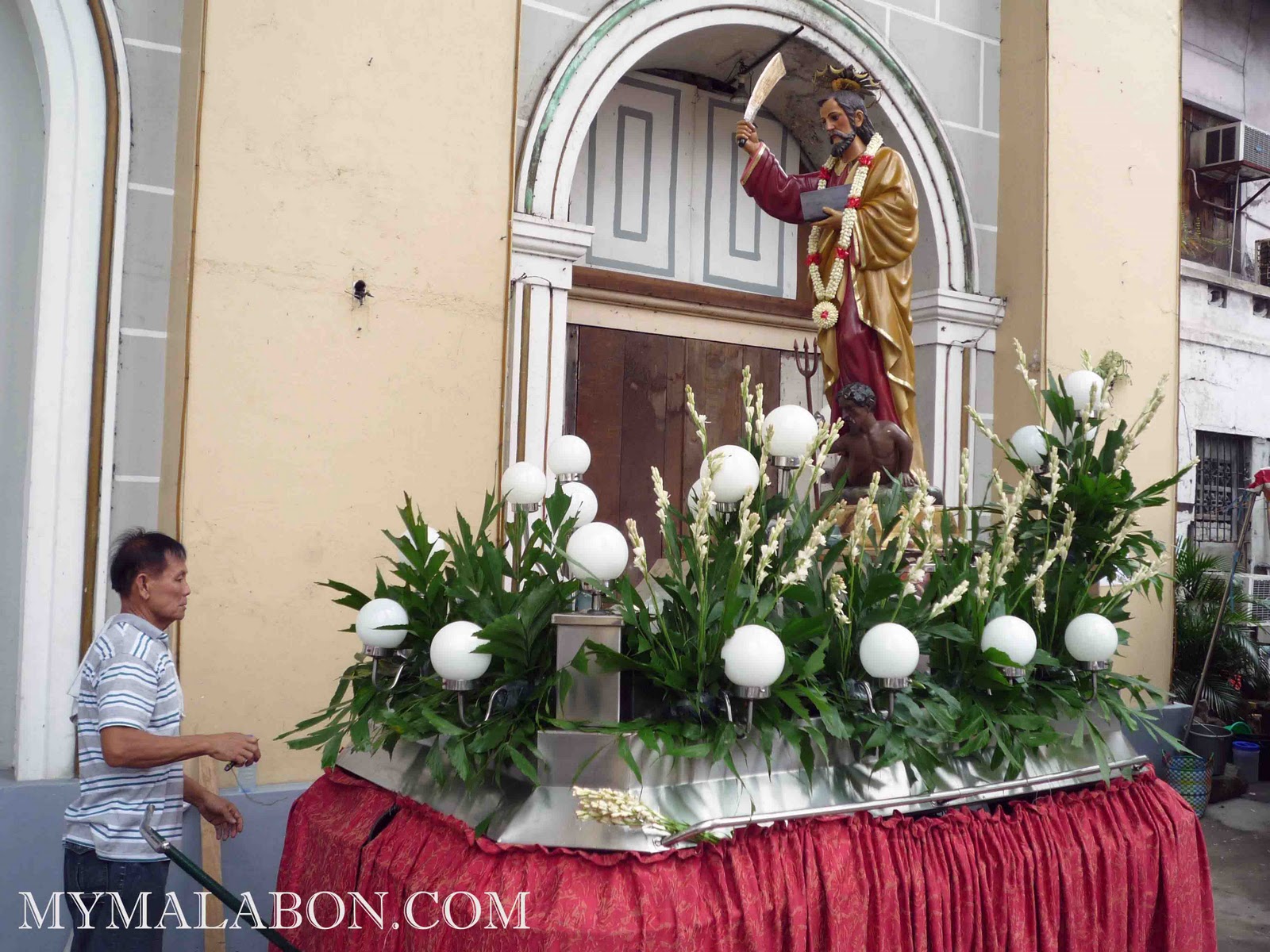 |
| San Bartolome getting ready for the evening procession |
 |
| Banda Pula Original of Malabon on the patio. |


 |
| Costumes for Sto. Nino statues. Filipinos like to dress up their Sto. Ninos in different attires. |
 |
| Colorful paper mache horses liven up the place. |
DISCOVERY OF THE DAY: MANG ROMY OF APALIT, PAMPANGA - LONE TABAK VENDOR AT MALABON'S 7th TABAK FESTIVAL

Yes, believe it or not, Mang Romy was the lone tabak vendor at the San Bartolome fiesta!
I walked the whole courtyard of San Bartolome; walked the stretch of Rizal Avenue from the corner of General Luna up to the City Hall; walked Leono and Manapat streets. Nothing. It was just Mang Romy in his stall near the parish convent building. When I asked him where the other tabak vendors were, he said they were in Nagcarlan, Laguna - where there was also a San Bartolome fiesta.
But you used to be so many out here, I said. I remember that well because we lived across San Bartolome church in the 1980s. Yes, he agreed, dense rows of tabak vendors used to line up the street during the fiesta. But since three years ago, his co-vendors have been choosing to go to Nagcarlan instead, because here in Malabon, sales are "matumal" (slow). Mang Romy chooses to go to Malabon, though, because it has been the family practice since his grandfather's time. I felt bad for him that I almost wanted to buy a bolo just so he could make a sale - but I didn't know how to buy one! And besides, my son and I were just going to ride a jeepney going back to Concepcion where we parked our car. I would not want to be carrying a bolo on the jeepney!
As I turned to walk towards General Luna, I looked back and a thought crossed my mind. If this trend continues, maybe next year, Mang Romy will opt to go where business is better, and go to Nagcarlan instead. If that happens, the only bolo that will be left to show at San Bartolome's fiesta in Malabon will be San Bartolome's bolo itself!
For Malabon, history, and nostalgia's sake, I hope that never happens...
1/ From Tambobong to the City of Malabon, by Nonoy Marcelo, 2004.
2/ History of Malabon-Navotas, by Salvador Sevilla, Santos Tiangco, 1976.
3/ http://www.italian-renaissance-art.com/Last-Judgement.html
4/ Andres Bonifacio The Eve of St. Bartholomew, by Nick Joaquin.
.
Saturday, August 14, 2010
Bits of History: A battle right in our own backyard
According to Arnaldo Dumindin in his narrative on "The Philippine-American War, 1899-1902," the Americans advanced to Malolos along the Manila-Dagupan railway on March 24-31, 1899. Their prime objectives were Malolos, the Filipino capitol, and the capture of Aguinaldo. But first they had to overcome defenses put up by Filipinos along the way.
Among the battles fought during that advance to the north was the BATTLE OF MALABON in 1899.

(Thanks to my brother-in-law Ramon for providing the link to these interesting bits of Malabon's history.)
.
Among the battles fought during that advance to the north was the BATTLE OF MALABON in 1899.
 |
| Americans line up waiting in a fishpond |
 |
| San Bartolome Church - proud but silent witness to the bravery of Filipinos during those times. |
 |
| Again, the San Bartolome Church - witness to history |
 |
| The Filipinos may have been captured, but they certainly gave the Americans a good fight, as shown in the news clipping below, where it says, "Americans found the insurgents hard to drive away." |

(Thanks to my brother-in-law Ramon for providing the link to these interesting bits of Malabon's history.)
.
Friday, July 16, 2010
San Bartolome Church - Seeking to Restore its Glory
The SAN BARTOLOME CHURCH - circa 1910 (photo from Arch. Richard Bautista):

SAN BARTOLOME CHURCH - circa Pre-war (photo from Old Philippines):

SAN BARTOLOME CHURCH today:

If there was one structure from the Malabon of old that never failed to take my breath away, it used to be the SAN BARTOLOME CHURCH in Bayan, in the heart of town.
The church was first built by the Spaniards in 1621 and finished in 1854. In 1861 the facade and its twin towers were constructed. The architecture of San Bartolome Church was simple and elegant but imposing. With its portico of Ionic columns reminiscent of a Greek temple, it was said to be "one of the most beautiful examples of ecclesiastical architecture that Spain has left the country." 1/
My husband, whose family lived in the area, remembers the church with its thick adobe walls in the 1950s. Around the 60s, the adobe walls were plastered with cement and painted a uniform color. The interior was mostly untouched, though, keeping its simple and dignified design with a few flourishes from the era. This was the church I became familiar with when I began studying at St. James Academy next-door up to the time when we lived in my husband's family home in Barangay Tanong from 1983 to 1991.
In the years that followed after we left Bayan, I had been hearing a lot about the renovations being undertaken in San Bartolome church, but I never paid much attention.
Well, today I decided to see for myself.
The sight of the familiar facade was comforting; the fake adobe drawings on the walls were not. Uh-oh, I said to myself. This is not very reassuring.
I stepped inside. I should have braced myself. I thought I had entered a different church.
Countless paintings and fluorishes have been added on walls, ceilings and arches where there used to be none. The traditional pulpit on the right side when you are facing the altar is no longer there. So with the crystal chandeliers of old; in their place are wrought iron lighting fixtures. Gold leaf touches and trimmings abound at every opportunity.


The walls that were previously being restored to bring out the original adobe have been plastered instead and fake adobe lines painted on them.

The original four evangelists paintings on the dome ceiling are no longer there; more vividly painted versions have taken their place. Even the dome architecture itself appears to have been changed.

So much has been re-done, removed, added, plastered, varnished, wallpapered, painted and repainted. Having known the church in its original state - simple and dignified - it now felt like a sensory overload, like it had become too dazzling and too opulent, when San Bartolome Church had never been that. I thought, "Are we in Rome or the Vatican?" and quickly realized that this was not a restoration I had just seen; this was an alteration - an extreme make-over, even.
And the alterations are still on-going, obviously, because the ceiling is still open and refinishing touches are still being done.
I don't recognize you anymore, my dear San Bartolome Church, I said to myself. What is left of you now, what vestiges of your centuries-old existence are left to tell us that you were once this serene and dignified sanctuary we knew and loved?
It felt like a part of me had been rudely snatched away. Dejected, I started to walk out and was consoled to find three things yet untouched --
The statue of San Bartolome on the main altar (at least I think it's still the original one):

The machuca tiles on the main aisle:

and the tombstones on the church columns:

But for how long?
As you enter the church, you will find the following sign on your left, which I didn't notice at once because I was drawn to the altar when I first entered:

I couldn't help asking myself, how do you define "glory," anyway? And how do you really restore it?
Certainly not by making something shiny and new and masking it with a gaudy veneer, but by reconstructing or rehabilitating it as faithfully as possible to the original. Old churches, especially, provide a valuable linkage into our own history as a people of faith. We should value and preserve them; to alter them is to deny future generations a precious legacy: a faithful glimpse into the past and an opportunity to be proud of ourselves as a people.
The renovation of San Bartolome Church has sought to restore its "glory."
And it has succeeded -- in a way that makes me profoundly sad for future generations...
______________________
1/ en.wikipilipinas.org
.
Subscribe to:
Posts (Atom)